Riding well on day three is a completely different skill from riding well on day one, and almost nobody trains for it.
A multi-day trip is the most common reason a recreational rider suddenly needs a quality they have never deliberately built. You can be perfectly fit for a hard three-hour ride and still find yourself walking the last climb on the third morning, because the thing that fails is not your ceiling. It is your ability to go back to a reasonable effort after having already done it twice.
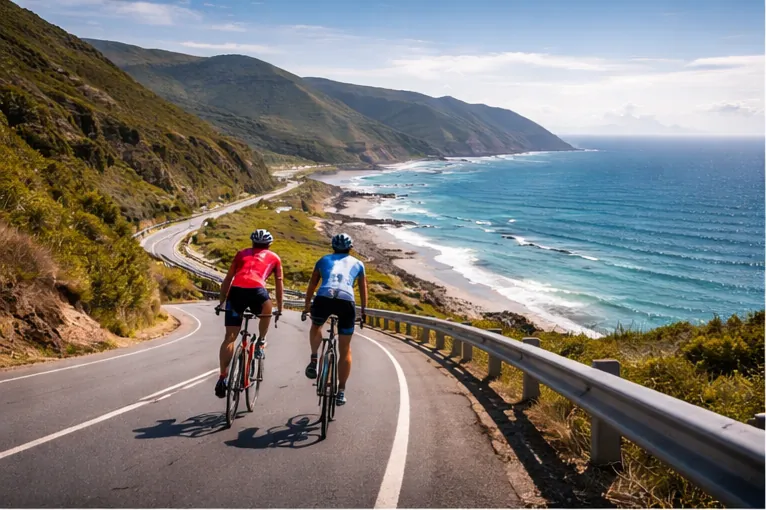
I use the Great Ocean Road as the example throughout, because a three to five day coastal tour with rolling terrain is close to the archetype of this problem. I should say plainly that I have not ridden it. What I can do is the training half, which is where nearly all the useful, transferable content is anyway, and the arithmetic that explains why day three goes the way it does.
What actually accumulates, and in what order
Four separate things stack up across consecutive days, and they do not stack at the same rate. Knowing which one is biting is what lets you fix it.
1. Glycogen, and this is the big one
This is worth doing properly, because the numbers surprise people. Take a four-hour day averaging 200 W.
Mechanical work: 200 W × 4 h × 3,600 s = 2,880 kJ
Human gross efficiency is around 20 to 25%, so total energy burned is roughly 2,880 ÷ 0.22 ≈ 13,100 kJ, about 3,100 kcal
At endurance intensity somewhere around half to sixty percent of that comes from carbohydrate, so call it 1,600 to 1,900 kcal, which is 400 to 475 g of carbohydrate
Total glycogen storage in a trained rider, muscle and liver together, is on the order of 400 to 500 g.
Read those two figures next to each other. A single moderate four-hour day is capable of consuming approximately your entire stored carbohydrate. If you do not replace it, and replacing it is harder than it sounds after a long day, you begin day two already down. Do that twice and day three starts from a hole that no amount of fitness fills.
The efficiency figure and the carbohydrate share are standard ranges from exercise physiology rather than anything measured on this site, and individual numbers vary a lot. The conclusion survives the uncertainty: at any plausible value in those ranges, a long day costs most or all of what you can store.
2. Sleep debt
Touring days start early and end late, and the sleep in between is often in an unfamiliar bed. Two short nights in a row does more damage to how a hard effort feels than the previous day's riding does.
3. Soft tissue and contact points
Saddle discomfort, hand numbness and neck tightness are cumulative in a way that fitness is not. They also have almost nothing to do with how strong you are, which is why strong riders are just as likely to be undone by them.
4. Motivation
The least discussed and, in my experience, the one that decides how the last day actually goes. Day three of a tour that has been paced badly is a psychological problem before it is a physical one.
Why normal training does not build this

A well-constructed training week deliberately separates hard days. That is correct if the goal is to maximise the quality of each session, which it usually is. It also means that in a normal block you almost never ask your body to do a substantial ride while still carrying yesterday's.
So a rider can arrive at a tour with a perfectly respectable FTP, a good power-to-weight ratio and no experience whatsoever of the specific demand the trip is about to make. The fitness is real. It is just aimed somewhere else.
The fix is not to train harder. It is to spend part of a block deliberately training tired, which is the one thing a structured plan is usually designed to avoid.
The back-to-back block
The core idea is simple: pair days. Instead of a single long ride at the weekend, ride two moderate days in a row and let the second one be the session that matters. The first day is not the training. The first day is the thing that makes the second day count.
Zwift is genuinely well suited to this, for an unglamorous reason. The second day of a pair is the one you most want to skip, and it is much easier to talk yourself into ninety minutes in the garage than into getting dressed for the weather.
A worked eight-week progression
Weekend pairs only. Whatever you do midweek stays as it was, with the caveat that the day before your first paired day should be easy.
| Week | Day one | Day two | Point of it |
|---|---|---|---|
| 1 | 90 min endurance | 75 min endurance | Establish that two days in a row is normal |
| 2 | 2 h endurance | 90 min endurance | Same, longer |
| 3 | 2 h 30 endurance | 2 h endurance | First day that will genuinely feel like something |
| 4 | 90 min easy | 60 min easy | Recovery week. Do not skip it |
| 5 | 3 h endurance | 2 h with 3 × 10 min tempo | Introduce quality on the second day |
| 6 | 3 h endurance | 2 h 30 with 4 × 10 min tempo | The key session of the block |
| 7 | 3 h 30 endurance | 3 h endurance, fuelled as if touring | Rehearse the eating, not just the riding |
| 8 | 2 h easy | 60 min easy | Taper into the trip |
Week six is the one that matters. Four ten-minute tempo blocks on the second consecutive day is a genuinely hard ask, and how it goes tells you more about your readiness for a tour than any test does.
This progression is my own construction from riding and reading rather than a validated protocol. The principles underneath it, progressive overload and a recovery week every fourth week, are standard, and there is more on how blocks fit together in the periodisation article.
Rehearse the eating, because that is what actually fails
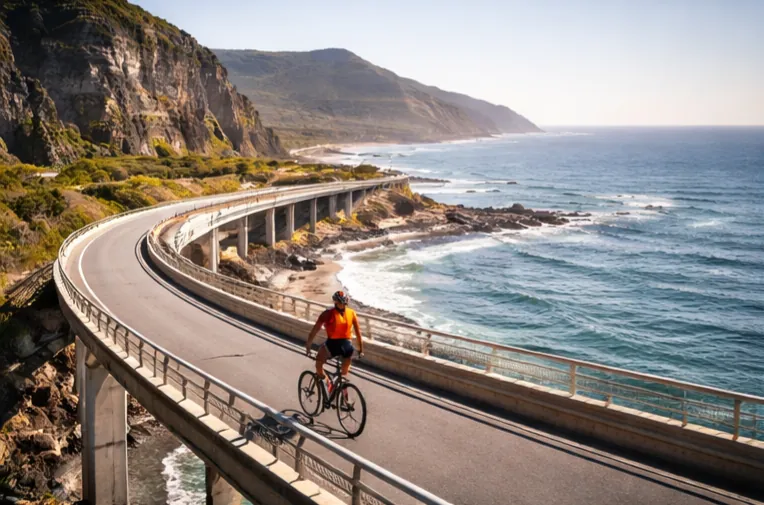
Go back to the arithmetic above. If a long day costs 400 g of carbohydrate and you can store roughly that much, then multi-day riding is an eating problem with a bicycle attached.
The practical version, in order of how much difference it makes:
- Eat on the bike from the first hour, not from the moment you feel empty. By the time you feel it, you are two hours behind.
- 60 to 90 g of carbohydrate an hour is the range most riders can absorb on a long day, and it takes practice to tolerate the top of it. This is exactly what the second long day of week seven is for.
- The hour after finishing is the highest-value eating of the trip, because it decides what you start tomorrow with.
- Practise with what you will actually eat. A gel you have never tried, on day two of a tour, is an experiment run at the worst possible moment.
If the cost of doing this properly is putting you off, the article on cheap fuelling works through what is actually inside a gel and how to reproduce it for very little money.
Pacing the trip: the day-one rule
Every account of a multi-day trip going badly that I have read or been told contains the same sentence somewhere near the start: the first day felt easy, so we pushed on.
The rule I would give, and this is judgement rather than data, is that day one should finish with you feeling like you cut it short. If day one leaves you satisfied, day three will not.
There is a concrete version of this. Decide the effort you intend to hold on the final day, and ride day one at that same effort or below. Not the same speed, since terrain and wind will not cooperate, but the same perceived effort. A tour paced to its last day rather than its first is a different holiday.
If you arrive undertrained, which is common
Trips get booked before blocks get finished. Illness, work and weather all interfere. Arriving with four weeks of the eight done is a normal situation and it is entirely salvageable, provided you change the plan rather than the effort.
The adjustments, in order of how much they buy you:
- Cut the daily distance before you cut anything else. Three comfortable days beat two good ones and a disaster. This is worth negotiating with the group before you start, not at lunchtime on day two.
- Drop your target effort by a full zone. If you planned to ride at the top of endurance, ride at the bottom of it. Undertrained riders need more margin, not less.
- Eat more, earlier, than you planned to. A lower fitness level means a higher proportion of carbohydrate burned at any given speed, so the fuelling problem is worse rather than better.
- Take the first climb of each day deliberately slowly. This is where undertrained riders lose their day, usually in the first hour, usually because the legs feel fine at that point.
- Plan an escape on every day. A shorter route, a train, a lift. Knowing one exists changes how the day feels even if you never use it.
The thing not to do is treat the trip as the missing training. A tour ridden at the effort you wish you were fit for produces one good day and two bad ones, and that arithmetic never improves.
Where indoor preparation runs out
Honest list, because the gap matters more on a tour than on a single ride.
- Descending. Coastal roads mean long descents with crosswinds. Zwift has no steering and no consequences.
- Position variety. Outdoors you move constantly. Indoors you do not, which is the whole subject of the article on what a fixed bike does to your body. Contact-point problems can be worse for an indoor-trained rider, not better.
- Loaded riding. If you are carrying luggage, train with it at least twice. The handling is different and so is the climbing.
- Weather. Being cold and wet for six hours is a skill and a kit problem, and you cannot rehearse either one in a garage.
The example itself
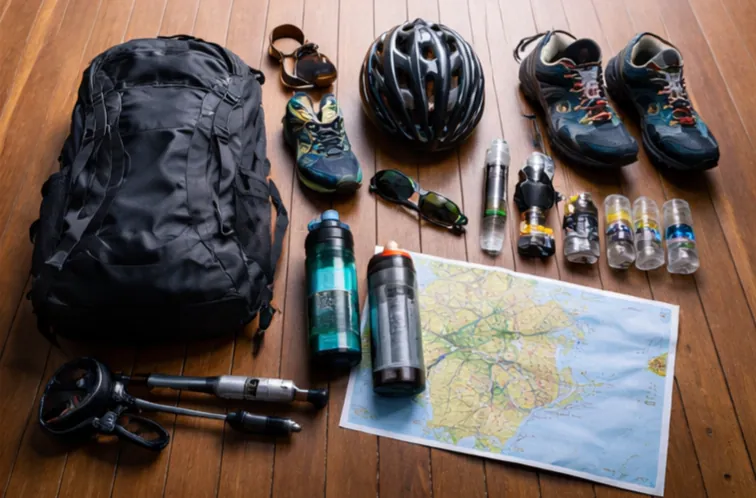
The Great Ocean Road runs along the Victorian coast in south-eastern Australia, and the section riders most often tour is the stretch between Anglesea and Apollo Bay, broken into three to five days. The terrain is described consistently as rolling rather than mountainous, with the inland Otways detour adding the only sustained climbing. Wind off the ocean is the variable everyone mentions.
That is the extent of what I can tell you with a straight face. I have not ridden it, and route-specific advice from someone who has not been there is exactly the sort of thing this site's editorial policy exists to prevent. For the trip itself, find someone who has ridden it.
Riders who have actually done it
The short version
- A four-hour day at 200 W costs roughly 400 to 475 g of carbohydrate. You can store 400 to 500 g. That single comparison explains most of what goes wrong on day three.
- Normal training separates hard days on purpose, so it never builds the ability to ride well on tired legs.
- Train in pairs. The second day is the session; the first day exists to make it count. Eight weeks of weekend pairs is enough.
- Rehearse eating 60 to 90 g of carbohydrate an hour before the trip, not during it.
- Ride day one at the effort you want to be holding on the last day.
About this article
Written by Christian Lassen Dam, who rides Zwift himself and builds every calculator on this site. Numbers here are either measured, and then linked to where they were measured, or modelled and estimated, and then labelled as such in the text. Spotted something wrong? Tell me and it gets corrected - the editorial policy explains how.
Related Articles
Continue reading with these related articles and guides:
Time of Day and Your Zwift Power: Finding Your Own Peak
Your power is not the same at 6 AM as at 6 PM, but nobody can tell you how large your own swing is. What actually moves across the day, why it moves, and a six-session protocol that measures the effect on you rather than on a study population.
What a Fixed Bike Does to Your Body That the Road Does Not
Outdoors you shift position constantly without noticing. Indoors the bike cannot move, so you stop moving too. What that does to your hands, knees, neck and lower back over a winter, and the changes that actually help.
Periodisation for Indoor Riders: Planning a Season on Zwift
Riding hard every week stops working after about two months. The three time scales a plan has to handle, a worked sixteen-week structure, how to plan backwards from a climb attempt, and why a permanent sweet spot block is the most common way to stall.
Power-to-Weight Ratio: Why It Decides Climbs and Little Else
Watts per kilogram predicts climbing speed because on a steep gradient nearly all your power goes into lifting your own mass. Where that stops being true, the two ways to move the ratio and why they are not equal, and the point at which chasing it backfires.
Run your own numbers
Every calculator on this site runs in your browser and publishes the equation behind it: