If you're new to Zwift, it can feel like you've walked into a cycling group ride where everyone speaks a slightly different language.
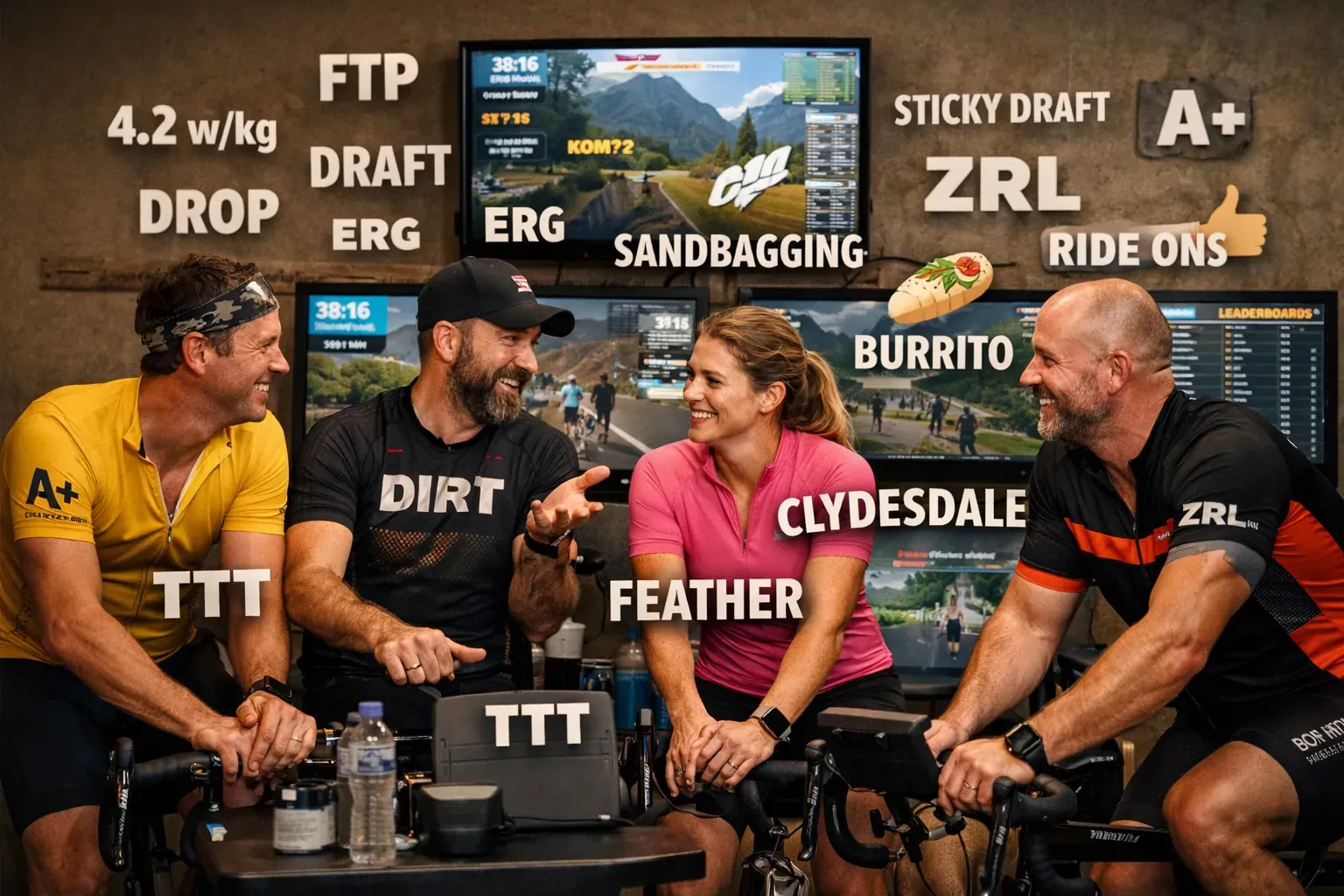
People throw around words like FTP, w/kg, draft, drop, ERG, TTT, sandbagging, Clydesdale, KOM, sticky draft, burrito, feather, A+, DIRT, ZRL, and ride-ons like it's normal conversation.
And it is - once you know what it all means.
Zwift has its own culture because it sits between three worlds:
- real cycling training
- video game systems
- online community racing
That combination creates terminology you won't fully learn from a normal cycling book. Some terms come from outdoor riding, some come from training science, and some are pure Zwift slang.
This guide is built to be genuinely useful. Not a dry dictionary. You'll learn what each term means, why it matters, and how to use it in real Zwift situations - training, group rides, racing, and even chatting.
You'll finish with a "translator brain" so you can read Zwift forums, Discord race chats, and in-game messages without feeling lost.
Core performance terms (the numbers Zwifters speak)
FTP (Functional Threshold Power)
FTP is the most common "anchor number" in Zwift.
It's a rough estimate of the highest power you can sustain for about an hour in a steady effort. In Zwift training plans, workouts, and racing categories, FTP is the key reference.
Why Zwifters talk about it constantly:
- it sets your training zones
- it affects your race category (through watts/kg)
- it helps you track improvement
How it shows up in conversation:
- "My FTP is 280 right now."
- "I'm doing an FTP builder block."
- "I think my FTP is set too high for ERG."
Important truth:
FTP is not perfectly "one hour power" for everyone. It's a training estimate. Two riders can have the same FTP and race very differently.
Watts (W)
Watts are simply power output.
Zwift is a power-based world. That's different from outdoor cycling for many people, where speed is often the obsession. In Zwift, speed depends on physics and drafting and weight. Power is what you actually control.
How it shows up:
- "Hold 300 W for this interval."
- "I pushed 500 W to close the gap."
Watts are absolute. But Zwift rarely uses watts alone.
w/kg (Watts per kilogram)
This is the currency of Zwift racing.
w/kg = your watts divided by your body weight in kilograms.
Why it matters:
- it predicts climbing speed very well
- it's used for race categories
- it's how people compare performance across sizes
How it shows up:
- "I can hold 4.0 w/kg for 20 minutes."
- "That was a 6 w/kg surge."
Big caution:
If your weight in Zwift is inaccurate, your w/kg is misleading and your racing category will be wrong. That's one reason Zwift racing has a lot of discussion around fairness.
Power zones (Z1 - Z7)
Most Zwifters use cycling zones based on FTP.
Typical zone idea:
- Z1: recovery (very easy)
- Z2: endurance (easy aerobic)
- Z3: tempo (steady "working")
- Z4: threshold (hard, sustainable)
- Z5: VO₂ (hard intervals)
- Z6: anaerobic (short, very hard)
- Z7: neuromuscular (sprints)
You'll hear:
- "This workout is mostly Z2 with Z4 blocks."
- "I'm doing sweet spot in Z3/Z4."
Zwift workouts often show these zones visually, so you learn the language quickly.
Sweet spot
Sweet spot is a popular training intensity: hard enough to build fitness efficiently, but not so hard that you need massive recovery.
It usually sits around the upper end of tempo into lower threshold.
In Zwift terms:
- "Sweet spot session" often means long blocks around 85-95% of FTP.
Why Zwifters love it:
- it's time-efficient
- it builds durability
- it's easier to repeat than full threshold
VO₂ max intervals
These are hard intervals designed to push aerobic capacity.
In Zwift, VO₂ workouts are common because:
- you can control the effort precisely
- you can do them safely indoors
- you don't need perfect roads or weather
You'll hear:
- "5x3 VO₂"
- "3-minute repeats"
- "On/off intervals"
Cadence (rpm)
Cadence is how fast you pedal.
Zwifters talk about cadence a lot because:
- ERG mode can punish low cadence with high torque
- cadence impacts comfort
- you can "spin" or "grind" depending on workout goals
Common talk:
- "I try to hold 90 rpm."
- "This climb is a grind at 70 rpm."
HR (Heart rate)
Heart rate matters, but in Zwift culture, it's usually secondary to power because:
- power is immediate output
- heart rate lags and shifts with heat, stress, fatigue
Still, you'll hear:
- "My HR drifted in that long ride."
- "My HR was too high for Z2."
Trainer and workout mode terminology (how Zwift controls your ride)
Smart trainer
A smart trainer is a trainer that can change resistance based on Zwift terrain or ERG targets.
If someone says:
"I'm on a smart trainer,"
they mean Zwift can control resistance.
Dumb trainer
A "dumb trainer" is a trainer that doesn't change resistance automatically. You can still use Zwift, but your resistance is manual.
Zwifters might say:
"I'm on a dumb trainer with a speed sensor."
This usually means less realism and less precision.
ERG mode
ERG is one of the most important Zwift training features.
ERG mode sets a target wattage and adjusts resistance so you hit that power regardless of gear - within reason.
Benefits:
- perfect for structured workouts
- makes intervals consistent
- reduces "chasing power" stress
Common complaints:
- "ERG spiral of death" (more on that soon)
SIM mode
This is the normal "ride the course" mode where resistance changes based on gradient, like outdoor riding.
Zwifters might say:
"I did it in SIM mode, not ERG."
Trainer difficulty
This is a Zwift setting that controls how strongly gradients affect your trainer resistance.
Important:
It does not make the ride "easier" in a magical fitness way. It changes how the gradient feels.
Example:
- 100% difficulty: a 10% climb feels like a 10% climb resistance-wise
- 50% difficulty: that same 10% climb feels like 5% resistance-wise, but you still need power to go fast
You'll hear:
- "What trainer difficulty do you run?"
- "I lowered it for Alpe du Zwift."
Spindown
A spindown is a calibration process for some trainers.
People talk about it because it affects accuracy.
You'll see:
- "Do a spindown before racing."
- "My numbers felt off until I calibrated."
Not all trainers need spindown in the same way. But the term is common.
Power match
PowerMatch is when Zwift uses an external power meter (like crank-based pedals) to control ERG, instead of trusting trainer power.
Zwifters discuss this because:
- trainer power can differ from power meter power
- matching makes training more consistent across indoor/outdoor
Dropout
A dropout is when your trainer, sensors, or connection fails and your power/cadence/heart rate disappears temporarily.
You'll hear:
- "I had dropouts mid-race."
- "My Bluetooth was unstable."
In-game racing and group ride terms (the "Zwift culture" words)
Draft / drafting
Drafting means riding behind someone to reduce wind resistance.
In Zwift, drafting is powerful and sometimes feels stronger than outdoors. Riders talk about:
- "Stay in the draft."
- "Don't pull too much."
Sticky draft
"Sticky draft" refers to how Zwift sometimes "holds" you in the draft if you're close enough, making it easier to stay with a group than in real life.
You'll hear:
- "Zwift has sticky draft - use it."
- "If you lose the wheel, it's hard to get back."
Wheel / holding a wheel
"Hold the wheel" means staying close behind a rider to draft them.
In race chat:
- "Hold the wheel!"
- "Don't get gapped!"
Gap
A gap is the distance between you and the group ahead.
In Zwift, a small gap can become a disaster quickly because:
- drafting benefit disappears
- the group pulls away at higher speed for same effort
You'll hear:
- "Close the gap now."
- "We got gapped on the hill."
Pack / bunch
The main group of riders.
Examples:
- "Stay with the pack."
- "I got dropped from the bunch."
Dropped
"Dropped" means you can't stay with the group.
Examples:
- "I got dropped on the climb."
- "He got dropped after the sprint."
Off the back
Same idea: you're behind the group and losing contact.
Examples:
- "I'm off the back."
- "I'm hanging on by a thread."
Breakaway
A rider or small group attacks and tries to ride away from the pack.
In Zwift, breakaways can be hard because drafting is strong and the pack can chase efficiently. But breakaways still happen, especially with teams.
Examples:
- "There's a break up the road."
- "We missed the break."
Chase / chasing
Trying to catch a breakaway or close a gap.
Examples:
- "We need to chase."
- "I burned matches in the chase."
Pull / taking a pull
Riding at the front to help the group maintain speed.
Examples:
- "Take a pull, then rotate."
- "Stop pulling so hard!"
Zwift group rides often have very uneven pulls because some people forget they're effectively "working" for everyone behind them.
Rotation
A smooth change of who's at the front.
You'll hear this in team time trials:
- "Rotate every 30 seconds."
- "Keep the rotation clean."
TTT (Team Time Trial)
This is a specific Zwift format where teams ride together, rotating, trying to get the best time.
In TTT talk you'll hear:
- "hold the blob"
- "smooth pulls"
- "don't surge"
- "keep it together"
Blob
The "blob" is the visual group of riders packed together.
People say:
- "Stay in the blob."
- "The blob split."
This is very Zwift-specific language.
Power-up terminology (Zwift's game mechanics)
Zwift has power-ups in many events. They're iconic and Zwifters refer to them by nickname.
Feather
Reduces your weight effect temporarily. Useful for climbs.
Examples:
- "Use feather on the climb."
- "Feather saved me on the hill."
Burrito
Disables drafting for a short time - both for you and behind you - often used strategically.
Examples:
- "Burrito on the sprint."
- "He burrito'd and messed up the draft."
Aero
Reduces aerodynamic drag. Great for flats and sprints.
Examples:
- "Save aero for the finish."
Ghost
Makes you invisible to others (and removes drafting effects). Used for attacks or confusion.
Examples:
- "He ghosted off the front."
Truck
Increases rolling resistance reduction (varies by mode). Often used on dirt or rough terrain routes.
People call it "the truck."
Important note:
Power-up availability depends on event types and modes. But the slang is common across Zwift communities.
Race category terminology (A, B, C, D... and the drama)
Categories: A, B, C, D (and sometimes A+)
These categories group riders by ability, often based on w/kg.
Typical ranges (these can vary depending on event rules):
- D: beginner/lower power
- C: intermediate
- B: strong amateurs
- A: very strong
- A+: elite-level in some systems
You'll hear:
- "I'm racing B tonight."
- "He should be in A, not C."
Sandbagging
This is the controversial term for someone racing in a lower category than they "should," often to win easily.
Examples:
- "That guy is sandbagging."
- "Classic sandbagger move."
Zwift tries to address this with enforcement systems in some events, but the term is still common.
Cat bump / upgrade
Moving to a higher category after improved performance.
Examples:
- "I got bumped to B."
- "Time for a cat upgrade."
ZwiftPower / results filtering
Many serious racers use external result systems (like ZwiftPower historically) or event-specific verification tools.
You'll hear:
- "Wait for ZwiftPower results."
- "He got filtered for weight doping."
The culture around results verification is part of Zwift racing.
Route and terrain terminology
Watopia
Zwift's most iconic world. Even people who don't ride Zwift know Watopia exists.
Examples:
- "Meet in Watopia."
- "I'm doing a Watopia route."
London, Richmond, New York, France, Innsbruck, etc.
Zwift has multiple worlds. Zwifters often choose worlds based on climbs or race routes.
KOM / QOM
King/Queen of the Mountain: timed climb segments.
Examples:
- "I'm going for the KOM."
- "I got a new PR on the KOM."
Sprint segment
Timed sprint sections.
Examples:
- "Save energy for the sprint segment."
Alpe du Zwift
Zwift's famous long climb (in Watopia), inspired by Alpe d'Huez.
Examples:
- "I'm doing Alpe."
- "Going for a sub-60 Alpe."
Epic KOM
Another famous climb.
Zwifters talk about these climbs like they're real landmarks, because in the Zwift world, they are.
Gear and setup terminology (Zwift-specific bike talk)
Tron bike
This is the "Zwift Concept Z1" bike, unlocked by earning enough elevation.
People call it the Tron bike because it looks futuristic.
Examples:
- "I finally got the Tron."
- "Tron on climbs is decent."
Drops (currency)
"Drops" are Zwift's in-game currency you earn by riding, used to buy bikes and wheels in the Drop Shop.
Examples:
- "I'm saving drops for a wheelset."
Drop Shop
The in-game store where you buy frames and wheels.
Examples:
- "Check the Drop Shop."
XP (experience points)
XP is earned through riding and unlocks levels and items.
Examples:
- "Grinding XP tonight."
- "Need XP for that frame."
Leveling up
Progressing through Zwift levels.
Social and chat terminology
Ride On
A "Ride On" is Zwift's version of a like/kudos.
Examples:
- "Thanks for the Ride On!"
- "Ride On bombing everyone today."
Beacon
A beacon is a visible indicator that helps others find you in a crowded world.
Examples:
- "Turn on your beacon."
Meetup
Scheduled ride with friends.
Examples:
- "Join my meetup."
Group ride
Organized ride with a leader, often with a specific pace.
Examples:
- "I'm doing a D group ride."
Training culture slang (the phrases Zwifters actually say)
"The pain cave"
Your indoor training space.
Examples:
- "Back in the pain cave."
- "Welcome to the pain cave."
"Zwift grind"
Long steady indoor riding or repeated training blocks.
Examples:
- "Another Zwift grind session."
"ERG spiral of death"
When ERG mode sets resistance to maintain power, and if your cadence drops, resistance rises, which makes cadence drop more, which makes it harder, and it spirals until you basically stop.
People describe it like:
- "I got ERG spiral of death."
- "Turn off ERG before you die."
The fix:
- shift to an easier gear before a hard interval
- keep cadence steady
- if it's going wrong, pause or lower the workout intensity temporarily
"Over/unders"
A workout pattern where you alternate slightly above and below threshold.
Examples:
- "Over/unders today."
- "That over/under set was brutal."
"Free ride"
Riding without a structured workout.
Examples:
- "Just doing a free ride."
"Workout bias"
Zwift riders sometimes refer to "being a workout person" vs "being a racer person."
- workout people love ERG, structure, consistency
- racer people love tactics, surges, and chaos
Many do both.
What terminology matters most for beginners?
If you only learn a few terms first, learn these:
- FTP
- watts and w/kg
- draft / wheel / gap
- ERG mode
- trainer difficulty
- dropped
- group ride pace categories
- Ride Ons
These will cover 80% of what you see.
Then add:
- sweet spot
- VO₂
- sandbagging
- power-ups
- drops / XP
And you'll speak Zwift fluently.
How to sound like you actually know what you're doing in Zwift chats
You don't need to fake it. But if you want to communicate clearly, here are examples of normal Zwift-speak:
- "I'm holding the wheel, don't want to get gapped before the climb."
- "Saving aero for the sprint, feather for the KOM."
- "ERG felt brutal - cadence dipped and I nearly spiral'd."
- "I'm doing sweet spot today, mostly Z3/Z4."
- "Got dropped on the kick, couldn't close the gap."
- "TTT rotation was messy, too many surges."
It's mostly just cycling language plus Zwift game layers.
A few "confusing terms" explained simply
"Trainer difficulty makes it easier, right?"
It changes the feel, not the physics. You still need power. Lowering trainer difficulty just means you shift less and feel less "wall" on steep climbs.
"Why is drafting so strong?"
Because Zwift is designed to make pack dynamics meaningful and fun, and because the system uses simplified physics that often makes drafting benefits very noticeable.
"Why do I get dropped so fast?"
Draft loss is brutal. A small gap becomes a big gap because the group ahead has drafting, and you don't.
The deeper point: Zwift terminology reflects Zwift skills
Learning the words helps you learn the skills.
When you understand terms like:
- "gap"
- "wheel"
- "draft"
- "surge"
- "pull"
you start making smarter decisions in races and group rides.
When you understand:
- "ERG"
- "sweet spot"
- "over/unders"
you start training with more structure and less guesswork.
Language shapes behavior.
And Zwift culture has grown because the platform forced cyclists to learn power-based training and group dynamics in a very visible way.
A practical mini-glossary (fast reference)
- FTP: your threshold power estimate
- w/kg: watts divided by weight, key for climbing and categories
- ERG: trainer holds target watts automatically
- SIM: resistance changes with terrain
- Trainer difficulty: changes gradient feel
- Draft: reduced effort behind riders
- Wheel: staying close behind someone
- Gap: distance between groups
- Dropped: can't stay with group
- Blob: packed group of riders
- TTT: team time trial
- KOM/QOM: timed climb segment
- Drops: in-game currency
- XP: experience points for leveling
- Tron bike: special unlock bike
- Ride On: kudos/like
- Sandbagging: racing below your true category
- Power-ups: feather, burrito, aero, ghost, truck
Final takeaway
Zwift terminology isn't just jargon. It's the language of:
- power-based training
- virtual racing tactics
- online community culture
Once you learn the key terms, Zwift gets more fun and less confusing. You'll understand workouts better, race smarter, and communicate with other riders without feeling like you missed a memo.
About this article
Written by Christian Lassen Dam, who rides Zwift himself and builds every calculator on this site. Numbers here are either measured, and then linked to where they were measured, or modelled and estimated, and then labelled as such in the text. Spotted something wrong? Tell me and it gets corrected - the editorial policy explains how.
Related Articles
Continue reading with these related articles and guides:
Time of Day and Your Zwift Power: Finding Your Own Peak
Your power is not the same at 6 AM as at 6 PM, but nobody can tell you how large your own swing is. What actually moves across the day, why it moves, and a six-session protocol that measures the effect on you rather than on a study population.
What a Fixed Bike Does to Your Body That the Road Does Not
Outdoors you shift position constantly without noticing. Indoors the bike cannot move, so you stop moving too. What that does to your hands, knees, neck and lower back over a winter, and the changes that actually help.
Periodisation for Indoor Riders: Planning a Season on Zwift
Riding hard every week stops working after about two months. The three time scales a plan has to handle, a worked sixteen-week structure, how to plan backwards from a climb attempt, and why a permanent sweet spot block is the most common way to stall.
Power-to-Weight Ratio: Why It Decides Climbs and Little Else
Watts per kilogram predicts climbing speed because on a steep gradient nearly all your power goes into lifting your own mass. Where that stops being true, the two ways to move the ratio and why they are not equal, and the point at which chasing it backfires.
Run your own numbers
Every calculator on this site runs in your browser and publishes the equation behind it: