The step from a two-hour ride to a five-hour one is not a fitness step. It is a fuelling and pacing step, and it catches out riders who are demonstrably strong enough.
This comes up most often when someone signs up for their first proper day out: a coastal classic, a charity ride, a sportive. They have been riding an hour or two several times a week for a year and they are fit. Then the day arrives and something goes wrong at hour three that has nothing to do with the numbers they have been training.
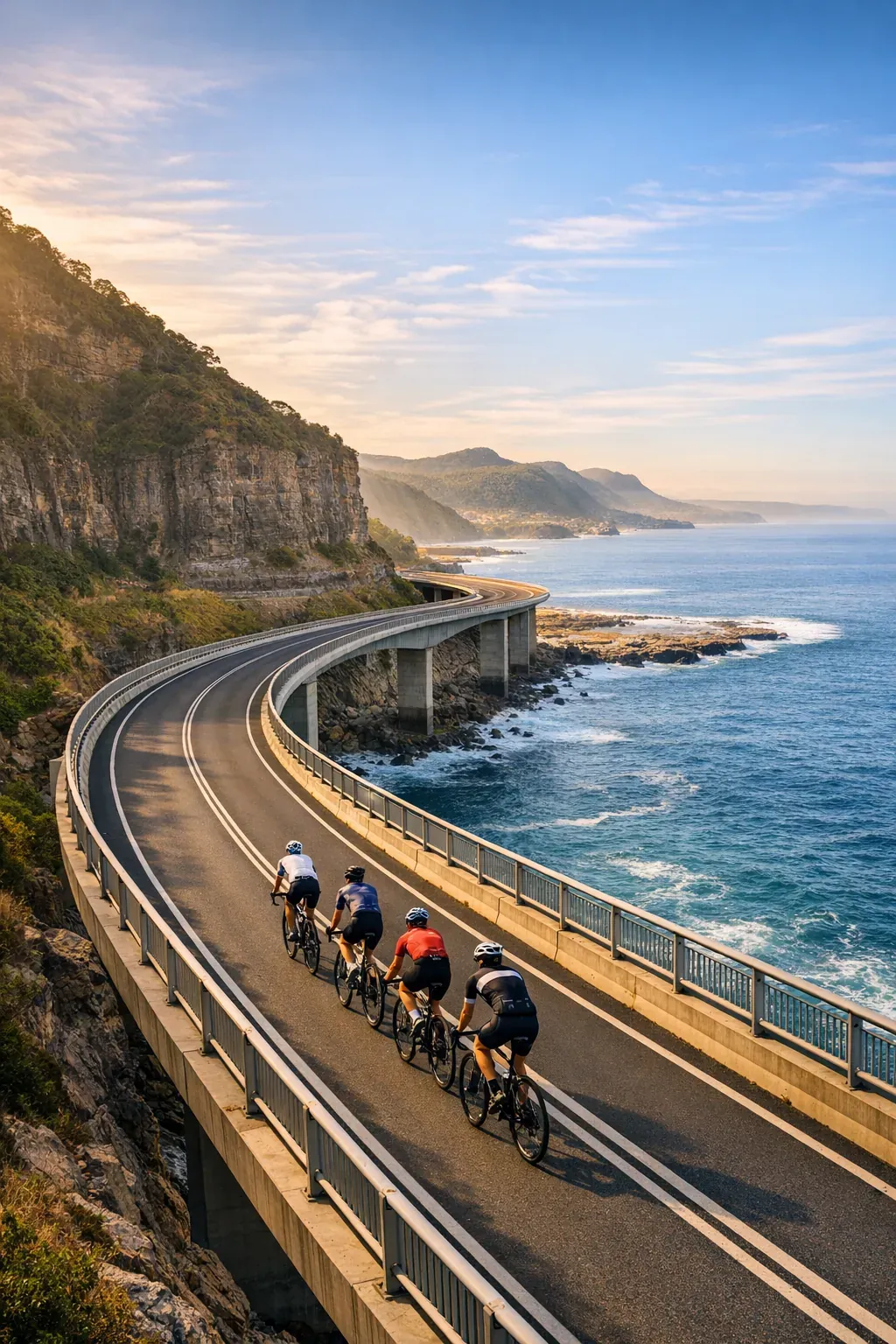
I use the Sydney to Wollongong ride as the example because it is close to the standard shape of a first long day: five-ish hours, coastal, one famous feature, achievable by a normally fit rider who paces it properly. I have not ridden it. The preparation is the part I can actually help with, and it is the part that decides how the day goes.
Five hours is not two hours plus three
At two hours you can get away with almost anything. You can start too hard and hang on. You can eat one bar and finish. You can wear whatever shorts were clean. None of that is true at five.
Roughly in the order they arrive, here is what actually fails:
| Roughly when | What goes | What actually caused it |
|---|---|---|
| Hour 2 | Contact points start talking | Position you have never held this long, not fitness |
| Hour 3 | Power quietly drops, effort feels the same | Carbohydrate deficit that started in hour one |
| Hour 3 to 4 | Appetite disappears entirely | Riding too hard for the gut to keep working |
| Hour 4 | Decisions get worse | Low fuel plus accumulated concentration |
| Hour 4 to 5 | Everything at once | All of the above, compounding |
Notice that fitness does not appear in the right-hand column. This ordering is my own from long rides and from watching people come apart on them, not a measured sequence, but the pattern is consistent enough that I would plan around it.
The pacing number, and why it feels insultingly easy

For a five-hour ride you want to average somewhere around 55 to 65% of FTP. If you do not know your FTP, the FTP calculator will turn a 20-minute or ramp test into a number and a set of zones.
For a rider with an FTP of 250 W that is 138 to 163 W as a five-hour average. Written down like that it looks like almost nothing, and this is precisely why people ignore it. On the road, at hour one, 150 W feels like you are being lazy.
Two things make that number less silly than it looks. First, it is an average across the whole ride including the climbs, so the flat sections have to sit below it for the climbs to fit above it. Second, the ride is not five hours of steady effort; it is five hours of terrain, and terrain always costs more than the plan.
The practical test, and this one is old and reliable, is that you should be able to hold a conversation in full sentences for the first three hours. If you cannot, you are riding your five-hour day at your three-hour pace, and the last two hours will collect the debt.
Eating: the rate matters more than the total
The single most common mistake is eating reactively. You feel fine, so you do not eat. Two hours later you feel empty, so you eat a lot, and now you have a gut problem on top of a fuel problem.
Carbohydrate absorption is rate-limited. You can take in roughly 60 g an hour of a single sugar source, and up to about 90 g an hour if the mix combines glucose and fructose, which is why most modern sports drinks do exactly that. You cannot bank it in advance and you cannot catch up later. Whatever you missed in hour one is gone.
The rule: start eating at 30 to 45 minutes, then every 20 to 30 minutes after that, whether or not you feel like it.
Setting a repeating timer is not excessive. At hour four you will not remember, and hour four is when it matters most.
Those absorption ranges are standard sports-nutrition figures, not something measured on this site. The practical point stands regardless of where in the range you personally sit: the rate is the constraint, and it starts binding from the first hour.
What hitting the wall actually is
Worth understanding properly, because knowing the mechanism tells you both how to avoid it and what to do if it happens anyway.
Your body stores carbohydrate in two places. Muscle glycogen, somewhere around 300 to 400 g, fuels the working muscle and is only available to that muscle. Liver glycogen, around 80 to 100 g, does a completely different job: it maintains the glucose concentration in your blood, and your brain runs almost entirely on that.
Heavy legs and falling power is muscle glycogen running low. Unpleasant, gradual, and you can ride through it at reduced output.
Hitting the wall is liver glycogen running out and blood glucose falling. Sudden, disproportionate, and it feels mental before it feels physical: everything becomes overwhelming, small decisions become difficult, and the world narrows.
Those are different failures and the second one is the frightening one. It is also the one that eating on a schedule prevents outright, because liver glycogen is small enough that regular modest carbohydrate intake keeps it topped up indefinitely.
If it happens: stop, eat something with fast sugar in it, and wait twenty minutes. Do not try to ride through it, because you cannot absorb much while working hard and you will simply prolong it. Twenty minutes and 60 g of carbohydrate turns a ruined day back into a slow one.
The storage figures are standard physiological ranges rather than anything measured here, and they vary with training status and body size. The distinction between the two failures is the part worth carrying.
Building to it on Zwift
The useful thing about doing this indoors is that a long ride is entirely controllable. No traffic, no mechanical stopping you, no getting cold, and your food is three metres away. That makes Zwift a better place to rehearse a long day than the road, right up until the point where you need to rehearse being outdoors.
A six-week build, on top of whatever else you do, with the long ride once a week:
- Week 1: 2 h at endurance pace. Eat 60 g of carbohydrate an hour even though you do not need to. This is a practice run for the eating, not the riding.
- Week 2: 2 h 30. Same fuelling. Note what your saddle has to say at the two-hour mark.
- Week 3: 3 h. This is usually the first ride where boredom becomes the limiter rather than the legs. Deal with that now rather than on the day.
- Week 4: 90 min easy. Recovery week.
- Week 5: 3 h 30 to 4 h, with the last hour deliberately at the effort you intend to finish the real ride on.
- Week 6: 2 h easy, then the ride itself.
You do not need to have ridden five hours to ride five hours. Four is enough, because the last hour on the day is carried by the occasion. Three is not enough, in my experience, because three hours is roughly where the problems start rather than where they finish.
Making a four-hour indoor ride survivable

This is the part nobody warns you about. A four-hour indoor ride is a genuinely different proposition from a four-hour outdoor one, and there is a craft to it.
Cooling, which is not optional at this length
Indoor sweat rates commonly run somewhere between 1 and 1.5 litres an hour with reasonable airflow, and higher without it. Over four hours that is four to six litres. You will not drink that much and you do not need to, but you do need to take it seriously enough to plan for, because dehydration on a long indoor ride arrives quietly and then all at once.
- More fan than you think, aimed at your chest and face rather than your legs.
- Two bottles within reach and a plan for refilling without stopping the ride.
- Electrolytes in at least one of them. Four hours of sweat is a meaningful sodium loss.
- A towel over the bars and another over the frame. The reasons are covered in the sweat article.
Boredom is a real limiter, so plan for it
Break the ride into segments with something happening at each transition. Ride a route that changes world or terrain. Put a film on for the middle two hours. Join a long group event so that the structure comes from outside you. What works is personal; what does not work is starting a four-hour ride with no plan for hours two and three.
Get off the saddle deliberately
The bike cannot move, so you have to. Stand for thirty seconds every ten or fifteen minutes even when you do not need to. It is the single most effective thing for making long indoor rides tolerable, and it is the same underlying problem described in the article on what a fixed bike does to your body.
What the road adds that the trainer cannot
Do at least two rides of three hours or more outdoors before the day, even if all your training has been indoors. Not for fitness. For the things fitness does not cover:
- Eating and drinking while moving, in traffic, with gloves on.
- Whether your kit actually works for five hours, which you cannot learn in ninety minutes.
- Descending with tired hands.
- Riding near other people, if the day involves a group.
- The simple business of being outside for that long. There is a fuller version of this argument in what Zwift can and cannot teach you.
The example itself

Sydney to Wollongong runs south down the New South Wales coast, and its famous feature is the Sea Cliff Bridge, a curved span built out over the water where the road was cut into the cliff. It is ridden as an organised event as well as independently, the terrain is described as rolling with a substantial climb leaving Sydney, and the consistent advice is to start early.
That is as far as I will go, because I have not ridden it and route-specific advice from someone who has not been there is worth nothing. For the details, ask someone local or watch someone who has done it.
Riders who have actually done it
The short version
- The jump to five hours is a fuelling and pacing problem, not a fitness one.
- Target 55 to 65% of FTP as the whole-ride average. It will feel too easy for the first two hours.
- Eat from 30 to 45 minutes in, then every 20 to 30 minutes. Absorption is rate-limited, so you cannot catch up.
- Six weeks with one long ride a week gets you there. Four hours in training is enough for five on the day.
- For long indoor rides: more fan than you think, stand up every ten minutes, and have a plan for hours two and three.
- Do at least two long rides outdoors before the day, for everything that is not fitness.
About this article
Written by Christian Lassen Dam, who rides Zwift himself and builds every calculator on this site. Numbers here are either measured, and then linked to where they were measured, or modelled and estimated, and then labelled as such in the text. Spotted something wrong? Tell me and it gets corrected - the editorial policy explains how.
Related Articles
Continue reading with these related articles and guides:
Time of Day and Your Zwift Power: Finding Your Own Peak
Your power is not the same at 6 AM as at 6 PM, but nobody can tell you how large your own swing is. What actually moves across the day, why it moves, and a six-session protocol that measures the effect on you rather than on a study population.
What a Fixed Bike Does to Your Body That the Road Does Not
Outdoors you shift position constantly without noticing. Indoors the bike cannot move, so you stop moving too. What that does to your hands, knees, neck and lower back over a winter, and the changes that actually help.
Periodisation for Indoor Riders: Planning a Season on Zwift
Riding hard every week stops working after about two months. The three time scales a plan has to handle, a worked sixteen-week structure, how to plan backwards from a climb attempt, and why a permanent sweet spot block is the most common way to stall.
Power-to-Weight Ratio: Why It Decides Climbs and Little Else
Watts per kilogram predicts climbing speed because on a steep gradient nearly all your power goes into lifting your own mass. Where that stops being true, the two ways to move the ratio and why they are not equal, and the point at which chasing it backfires.
Run your own numbers
Every calculator on this site runs in your browser and publishes the equation behind it: